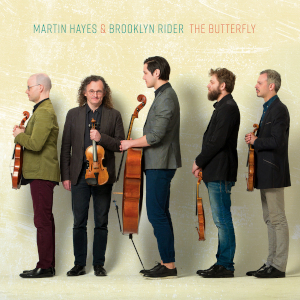
Martin Hayes & Brooklyn Rider (Ireland/USA)
The Butterfly (2019)
12 tracks, 45 minutes
Bandcamp ∙ Spotify ∙ iTunes
I usually think of Irish folk music as usually falling within one of two broad categories: perky, fast and often boisterous tunes made for dancing; and long and fairly slow songs of lament. Fiddler Martin Hayes has long been a proponent of a third way: he plays his tunes slowly, giving a repertoire originally meant for dance a different meaning. Under his bow, the melodies have longer to lie on the air before reaching the ear, and this lends a sort of maturity to their sound; this can mean that they can perhaps have a slightly melancholy tone, or a more thoughtful one, or maybe one that conveys a wise and knowing smile.
With this album, released earlier this year, Hayes’ signature style is given a perfect setting from the unlikely source of Brooklyn Rider. They’re a string quartet from New York that work somewhat in the Kronos Quartet mould, performing contemporary and avant-garde classical music and frequently collaborating with artists of different genres from all over the world, including Iranian kamancheh player Kayhan Kalhor and roots banjo player Béla Fleck.
Here, the collaborators do what they do, and the marriage is beautiful. Hayes plays his fiddle in his calm and considered way, and Brooklyn Rider’s refined but explorative arrangements putting the Irish melodies into a context that allow them to breathe. The quartet play lively when needed, weaving Hayes’ lines with countermelodies, harmonies and even miniature rounds as appropriate, but they can also sometimes act as a breeze, playing long, floating notes that quaver and flutter occasionally, but allow the fiddle melodies to echo out into the distance, as if they’re being played to a hill, a cloud, a spring or the sea.
It’s always a risky business to bring classical music into a type of music that…well, basically, isn’t classical music. The western classical form has led to the creation of wondrous works for many centuries, but it also brings with it many rules and conventions that are often strictly applied. When classical music is used in fusions, it must be very carefully applied, in case these restrict the characteristics of the other styles or the musical freedom of any collaborators involved. The Butterfly represents the optimum classical collaboration – neither party steps on the other’s toes, while both craft their own sounds to bend in the direction of the other, enough to work in harmony but keep their own sound strong at the same time.
The Butterfly is a lovely record that shows relatively little-heard side to Irish folk music while taking it to a different sphere – and introducing the folk aspect into the classical sphere as well. An unexpected delight for me, and one of my albums of the year.
My 2019 challenge: I'm going to post a little something about an album (or somesuch) that I like every single day. Written by Jim Hickson.
Showing posts with label Ireland. Show all posts
Wednesday, 18 December 2019
Sunday, 22 September 2019
265: Volume 1: Sound Magic, by Afro Celt Sound System
Afro Celt Sound System (United Kingdom/Ireland/Senegal)
Volume 1: Sound Magic (1996)
9 tracks, 66 minutes
Bandcamp ∙ Spotify ∙ iTunes
This is the second time we’ve encountered the Afro Celt Sound System on this blog, and this time we’re actually talking about a real album. In total, ACSS went on to release a total of five studio albums in their original incarnation and a further two (so far) in their current set-up with a different core membership. But of all those albums, it is still this one, their very first, that grabs me the most and grabs me hardest.
The excitement of the record is palpable in its music. World music fusions had been created before this point, but 1996 was still a time when it felt like everything was possible and full of potential – as opposed to now, where it does feel a little bit as if almost every conceivable crossover has already been attempted. When Sound Magic first arrived, nothing like this had been heard before. The combination of Irish and Scottish music with West African music was already exhilarating – firstly in even daring to bring two such apparently distant traditions together as one, and then, on listening, the amazement that the styles worked together so well – but to also set that meeting in the sonic surrounds of club, rave and dub music just adds a hundred possible more mouth-watering directions for completely new experimentation.
When I play this album today, all those possibilities and the surprises they conjure up still send me reeling. Senegalese kora dueting with Irish sean nós singing; tama and bodhrán drums trading rhythms while weaving between programmed beats; very-90s-sounding synths taking their rightful place alongside uilleann pipes and low whistles in the Irish heterophony; snatches of sounds from other traditions here and there in the Armenian duduk, Kenyan nyatiti and Siberian throat singing. Even now, after nearly 25 more years of musical innovations since, it still sounds a little hard to believe, but each combination manifests beautiful flowers.
There’s barely a wrong musical turn on the whole album, which is even more incredible when it’s taken into account that these musicians often couldn’t speak the same language. They were making up the rules on the fly and communicating through their instruments. It doesn’t become a confusing amalgam either, where everything is thrown together with a dance beat and a hope that people will be too busy moving to pay too much attention, as some fusions tend to sound like. No, there’s an obvious amount of deep and careful thought behind every piece of music, every texture change and every new instrument introduced. The club bangers work brilliantly – ‘Whirl-y-Reel 1’ is still an enduring favourite in my bounce-your-head-off moments – but the long, thoughtful and calm pieces such as the final medley ‘Eistigh Liomsa Sealad/Saor Reprise’ are just as delightful and perfectly complementary.
One of the reasons the Afro Celt Sound System were so exciting was precisely because the Afro Celt Sound System had never existed before, not only in our realm, but even in most of our wildest imaginations. That some imaginations could fathom such an ensemble, such an unexpected sound, is something that the rest of us must be thankful for. ACSS changed the face of world music and their impact on how musicians and audiences approach cross-cultural fusions cannot be overstated. And it all started, appropriately, with Volume 1…Sound Magic indeed.
Volume 1: Sound Magic (1996)
9 tracks, 66 minutes
Bandcamp ∙ Spotify ∙ iTunes
This is the second time we’ve encountered the Afro Celt Sound System on this blog, and this time we’re actually talking about a real album. In total, ACSS went on to release a total of five studio albums in their original incarnation and a further two (so far) in their current set-up with a different core membership. But of all those albums, it is still this one, their very first, that grabs me the most and grabs me hardest.
The excitement of the record is palpable in its music. World music fusions had been created before this point, but 1996 was still a time when it felt like everything was possible and full of potential – as opposed to now, where it does feel a little bit as if almost every conceivable crossover has already been attempted. When Sound Magic first arrived, nothing like this had been heard before. The combination of Irish and Scottish music with West African music was already exhilarating – firstly in even daring to bring two such apparently distant traditions together as one, and then, on listening, the amazement that the styles worked together so well – but to also set that meeting in the sonic surrounds of club, rave and dub music just adds a hundred possible more mouth-watering directions for completely new experimentation.
When I play this album today, all those possibilities and the surprises they conjure up still send me reeling. Senegalese kora dueting with Irish sean nós singing; tama and bodhrán drums trading rhythms while weaving between programmed beats; very-90s-sounding synths taking their rightful place alongside uilleann pipes and low whistles in the Irish heterophony; snatches of sounds from other traditions here and there in the Armenian duduk, Kenyan nyatiti and Siberian throat singing. Even now, after nearly 25 more years of musical innovations since, it still sounds a little hard to believe, but each combination manifests beautiful flowers.
There’s barely a wrong musical turn on the whole album, which is even more incredible when it’s taken into account that these musicians often couldn’t speak the same language. They were making up the rules on the fly and communicating through their instruments. It doesn’t become a confusing amalgam either, where everything is thrown together with a dance beat and a hope that people will be too busy moving to pay too much attention, as some fusions tend to sound like. No, there’s an obvious amount of deep and careful thought behind every piece of music, every texture change and every new instrument introduced. The club bangers work brilliantly – ‘Whirl-y-Reel 1’ is still an enduring favourite in my bounce-your-head-off moments – but the long, thoughtful and calm pieces such as the final medley ‘Eistigh Liomsa Sealad/Saor Reprise’ are just as delightful and perfectly complementary.
One of the reasons the Afro Celt Sound System were so exciting was precisely because the Afro Celt Sound System had never existed before, not only in our realm, but even in most of our wildest imaginations. That some imaginations could fathom such an ensemble, such an unexpected sound, is something that the rest of us must be thankful for. ACSS changed the face of world music and their impact on how musicians and audiences approach cross-cultural fusions cannot be overstated. And it all started, appropriately, with Volume 1…Sound Magic indeed.
Friday, 16 August 2019
228: A Gathering of Strangers, by UNITE: Urban Native Integrated Traditions of Europe
UNITE: Urban Native Integrated Traditions of Europe (United Kingdom/Bulgaria/Ireland/Hungary/others)
A Gathering of Strangers (2010)
15 tracks, 70 minutes
Spotify ∙ iTunes
UNITE were a one-album (and I think one-tour) project that came into being, said what they wanted to say and faded away into their constituent parts again. Their only-slightly-awkward backronym Urban Native Integrated Traditions of Europe gives you some idea of what they’re about. Recorded across seven European capital cities and featuring urban folk musicians from even more, this album is the sound of a Europe under one banner, making brilliant music all together, making exciting new styles while all retaining their own unique identities.
That’s right: it’s a Brexit protest! Except, it was released six years before anyone realised it was much of a problem at all and when Nigel Fridge was just a fringe nutter instead of an apparently mainstream nutter. Not that there weren’t already concerning signs: the whole reason this album was made was to show the foolishness of xenophobia and to highlight in its own small way the values of intercultural exchange and bridge building.
The project itself was spearheaded by Tim Whelan and Hamid Mantu, the core duo behind Transglobal Underground. Although the album ostensibly revolves around its guest stars and the collaborations thereof, for my money, it’s clearly at its strongest musically when they let the TGU-iness to flow forth and build up vast layers of the dubtronica in and throughout all the other influences, like some mad lasagne. Whether it’s Bulgarian bagpipes and choirs, Czech dubstep, Victorian music hall songs or whatever the next artist brings, it’s all held firmly in place as an important element of the overall sound. I think the best run to demonstrate this is the three tracks of ‘Karanka’, ‘Van Dieman’s Land’ and ‘Immigrant Song’, with that middle track being the one I come back to the most. Based on an old British transportation ballad, provided here by Irish musician Martin Furey, it also includes half-sung half-rapped Mandinka from Czech-Senegalese singer Bourama Badji and Polish throat-singing from Bart Pałyga. It’s like some strange alternate universe where the concept behind the Afro Celt Sound System bore fruit with TGU at the helm instead, and it’s full of that slight darkness that TGU are brilliant at curating.
There are so many different influences going on here that it’s not possible to describe it all together, but that’s not really the point. It’s all good stuff and it’s the plurality and heterogeneity that makes it so – it revels in it. The saddest thing is that this album, the UNITE project and the messages at the heart of both have only become more relevant over the past nine years, rather than an artefact of their own time. I hope it can start becoming less relevant – if no less banging – as soon as possible.
A Gathering of Strangers (2010)
15 tracks, 70 minutes
Spotify ∙ iTunes
UNITE were a one-album (and I think one-tour) project that came into being, said what they wanted to say and faded away into their constituent parts again. Their only-slightly-awkward backronym Urban Native Integrated Traditions of Europe gives you some idea of what they’re about. Recorded across seven European capital cities and featuring urban folk musicians from even more, this album is the sound of a Europe under one banner, making brilliant music all together, making exciting new styles while all retaining their own unique identities.
That’s right: it’s a Brexit protest! Except, it was released six years before anyone realised it was much of a problem at all and when Nigel Fridge was just a fringe nutter instead of an apparently mainstream nutter. Not that there weren’t already concerning signs: the whole reason this album was made was to show the foolishness of xenophobia and to highlight in its own small way the values of intercultural exchange and bridge building.
The project itself was spearheaded by Tim Whelan and Hamid Mantu, the core duo behind Transglobal Underground. Although the album ostensibly revolves around its guest stars and the collaborations thereof, for my money, it’s clearly at its strongest musically when they let the TGU-iness to flow forth and build up vast layers of the dubtronica in and throughout all the other influences, like some mad lasagne. Whether it’s Bulgarian bagpipes and choirs, Czech dubstep, Victorian music hall songs or whatever the next artist brings, it’s all held firmly in place as an important element of the overall sound. I think the best run to demonstrate this is the three tracks of ‘Karanka’, ‘Van Dieman’s Land’ and ‘Immigrant Song’, with that middle track being the one I come back to the most. Based on an old British transportation ballad, provided here by Irish musician Martin Furey, it also includes half-sung half-rapped Mandinka from Czech-Senegalese singer Bourama Badji and Polish throat-singing from Bart Pałyga. It’s like some strange alternate universe where the concept behind the Afro Celt Sound System bore fruit with TGU at the helm instead, and it’s full of that slight darkness that TGU are brilliant at curating.
There are so many different influences going on here that it’s not possible to describe it all together, but that’s not really the point. It’s all good stuff and it’s the plurality and heterogeneity that makes it so – it revels in it. The saddest thing is that this album, the UNITE project and the messages at the heart of both have only become more relevant over the past nine years, rather than an artefact of their own time. I hope it can start becoming less relevant – if no less banging – as soon as possible.
Subscribe to:
Posts (Atom)


