Showing posts with label Classical. Show all posts

Sunday, 29 December 2019

363: I Eat the Sun and Drink the Rain, by Sven Helbig

Sven Helbig (Germany)
I Eat the Sun and Drink the Rain (2016)
10 tracks, 43 minutes
BandcampSpotifyiTunes

Classical music has been used to complement and add melodic interest to electronic dance music since the latter genre’s beginnings – when you think of those epic, anthemic dance tracks, that classical sound is particularly strong, either from samples of big sweeping strings or the influence of the awe-inspiring impact of a huge symphony orchestra in full flight. The use of club music in classical styles, however, is explored much less often.

Composer Sven Helbig, in his work I Eat the Sun and Drink the Rain, brings electronics into his music in a way that complements the classical, rather than the other way around. The principle sound here is choral music, the voices contributed by the Vocalconsort Berlin. It’s a very old sound. The choir sing in reverential tones and the harmonies and counterpoint that are used are reminiscent of medieval music – mostly using wide open chords which occasionally drift into friction-filled dissonances with pleasing resolutions – but they do lean in subtly unorthodox directions now and again, showing the influence of modern art music and even jazz, but only in a way that benefits the overall atmosphere. Although Helbig himself wrote many of the texts that are sung throughout the work (in German), the sacred sound is made solid with the inclusion of the Kyrie and the Agnus Dei, both common elements of the sung Latin mass. The composition for choir alone is suitably beautiful, powerful and haunting.

So far, so classical. But Helbig’s work comes into its own with the use of live electronics, performed by the composer himself. The way he uses the electronic sounds is very similar to the way they’re used in house music, but the context in which they’re used gives those sounds a very different feel. He basically takes the exact opposite direction to club music: the beat is far from the main focus, to the degree that it is hardly present at all. Where a ‘beat’ is manifested, it’s a world away from four-to-the-floor kick and clap-snare; rather, it is a subdued, even shy, rhythm described by a crunchy synth hit of a similar quality to a bendir frame drum. Instead, the dance music makes itself heard in its texture the way its sounds and effects are layered up. A great example is in the track (or, in Helbig's terminology, ‘episode’) of ‘Kyrie’. The first sound heard is an electronic drone. The note provided by the drone stays consistent but its harmonic quality is ever-shifting. As the choir comes in with their overlapping lines, the drone seems to ‘pick up’ on the sound of their voices, and the reverb and delay effects fold those voices back into the drone so that it evolves throughout the piece. At points, it means that it is hard to distinguish whether you’re hearing human voice or synthesised tone.

This use of electronic sounds and influences from dance music in I Eat the Sun and Drink the Rain are so subtle that it seems strange to focus on, but it nevertheless defines the sound. Most of the time, the listener will probably be unaware of the impact of these elements – that’s the point, after all – but without them it would be such a completely different atmosphere, and probably one ‘lacking’ in some indiscernible way. To use any sonic element in such an all-important yet understated way is the sign of acute musical intelligence, and to marry classical and religious choral music with electronic dance music in such a way is absolutely fascinating and shows real, felt knowledge of both styles. If classical music has a raison d’être it must surely be to look into the past and future in equal measure – in this work, Sven Helbig captures that dual consciousness in the most satisfying way.
Wednesday, 18 December 2019

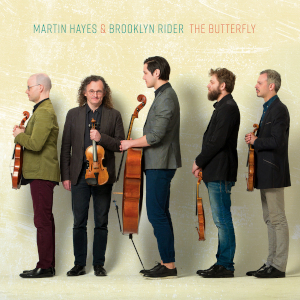
352: The Butterfly, by Martin Hayes & Brooklyn Rider

Martin Hayes & Brooklyn Rider (Ireland/USA)
The Butterfly (2019)
12 tracks, 45 minutes
BandcampSpotifyiTunes

I usually think of Irish folk music as usually falling within one of two broad categories: perky, fast and often boisterous tunes made for dancing; and long and fairly slow songs of lament. Fiddler Martin Hayes has long been a proponent of a third way: he plays his tunes slowly, giving a repertoire originally meant for dance a different meaning. Under his bow, the melodies have longer to lie on the air before reaching the ear, and this lends a sort of maturity to their sound; this can mean that they can perhaps have a slightly melancholy tone, or a more thoughtful one, or maybe one that conveys a wise and knowing smile.

With this album, released earlier this year, Hayes’ signature style is given a perfect setting from the unlikely source of Brooklyn Rider. They’re a string quartet from New York that work somewhat in the Kronos Quartet mould, performing contemporary and avant-garde classical music and frequently collaborating with artists of different genres from all over the world, including Iranian kamancheh player Kayhan Kalhor and roots banjo player Béla Fleck.

Here, the collaborators do what they do, and the marriage is beautiful. Hayes plays his fiddle in his calm and considered way, and Brooklyn Rider’s refined but explorative arrangements putting the Irish melodies into a context that allow them to breathe. The quartet play lively when needed, weaving Hayes’ lines with countermelodies, harmonies and even miniature rounds as appropriate, but they can also sometimes act as a breeze, playing long, floating notes that quaver and flutter occasionally, but allow the fiddle melodies to echo out into the distance, as if they’re being played to a hill, a cloud, a spring or the sea.

It’s always a risky business to bring classical music into a type of music that…well, basically, isn’t classical music. The western classical form has led to the creation of wondrous works for many centuries, but it also brings with it many rules and conventions that are often strictly applied. When classical music is used in fusions, it must be very carefully applied, in case these restrict the characteristics of the other styles or the musical freedom of any collaborators involved. The Butterfly represents the optimum classical collaboration – neither party steps on the other’s toes, while both craft their own sounds to bend in the direction of the other, enough to work in harmony but keep their own sound strong at the same time.

The Butterfly is a lovely record that shows relatively little-heard side to Irish folk music while taking it to a different sphere – and introducing the folk aspect into the classical sphere as well. An unexpected delight for me, and one of my albums of the year.

Wednesday, 11 December 2019

345: White Elephants & Golden Ducks: Enchanting Musical Treasures from Burma, by Various Artists

Various Artists (Burma)
White Elephants & Golden Ducks: Enchanting Musical Treasures from Burma (1997)
16 tracks, 72 minutes
SpotifyiTunes

To be honest, the album that I was actually intending to write about today was Birmanie: Musique d’Art released on Ocora in 1981, but I couldn’t find anywhere for you to listen to it or download it on the internet, so I thought I’d give you this one instead. Maybe Ocora will rerelease that compilation at some point as they have been doing with a lot of their recordings, but either way, if you get a chance to listen to it, it’s a really nice set of all different classical music traditions from Burma, so definitely give that a go. But for now, this is something (ever so slightly) different…

Where the Ocora release deals with only the strictest definitions of Burmese classical music, played on all traditional instruments and in traditional ensembles such as the hsaing waing orchestra, White Elephants & Golden Ducks presents a much more contemporary view of that art music culture. The traditional instruments are still there to be enjoyed in all their glory: the pat waing tuned drums are always a scintillating sound, and the kyey (metallophones similar to an Indonesian gamelan), saung harp, pattala xylophone, hne shawm and palwei flute all play important roles on this album. That’s not all, though – there’s also a variety of western instruments showcased throughout the album, all lent interesting twists in the context of the Burmese classical style.

Although there is violin here, played by U Tin Yi, with its similarities to the traditional Burmese fiddles, it is perhaps surprising that it is not the instrument that lends itself to the styles on show in the most natural way. That would instead be the acoustic slide guitar, played here by U Ohn Lwin. The instrument’s guttural tones put it in the same aural region as the saung, and it is used in a similar way, but its ability to slide, vibrato and bend notes lend the slide guitar its very own place within the style, and it feels completely at home. The instrument that is a real wildcard here, though, is the piano of U Yee Nwe. The way he plays accentuates its status as a percussion instrument, using it in much the same way as the pattala and the pat waing, with all the same sorts of ornaments. However, it has a really uncanny ring to it. Unlike the violin or slide guitar, the piano is locked into playing in western-style tuning of equal temperament, which is at odds with the Burmese way of tuning. In playing the pieces to the closest approximation of the Burmese notes, though, it introduces all sorts of unusual lopsided melodies and harmonies, often with lots of clashing, close together notes played at the same time. The effect is not unpleasant, but it’s played in such a singular way that whether you’re coming at it with western ears or even off the back of listening to lots of Burmese music, it is a really odd sound. Give yourself a moment to adjust and it will all become clear.

The use of instruments in this way is fun, but what I really love about Burmese classical music is that it is so unique. Different elements of the pieces can bring to mind art music from surrounding cultures – Indian sometimes, Chinese others, Thai and even Indonesian resonate in there too – but the way they are pieced together is heard nowhere else. It’s the same thing that I’ve talked about in regards to music all around the world: the way Burmese music is constructed could only ever have occurred in Burma, reflecting perfectly its cultural geography in relation to its neighbours. And obviously it’s true of all of those neighbouring cultures as well, which would not sound the same if it weren’t for Burmese music through the ages. With enough research, I’m sure you could build up a whole global map of music in this way, tracing lines of compounding influence from one group of people to the next to create magical chains thousands of miles long, and steeped in just as many years of history.

If you have never listened to Burmese classical music before (aside from the solo saung of Hlaing Win Maung, which you obviously listened to and loved back in May when I wrote about it here), both White Elephants & Golden Ducks and, if you can find it, Birmanie: Musique d’Art are perfect entry points. There’s lots to recognise in there, but you won’t have heard anything like it before.

Saturday, 2 November 2019

306: Grim Fandango Remastered: Original Soundtrack, by Peter McConnell & Melbourne Symphony Orchestra

Peter McConnell & Melbourne Symphony Orchestra (USA/Australia)
Grim Fandango Remastered: Original Soundtrack (2015)
37 tracks, 60 minutes
SpotifyiTunes

With bony hands I hold my partner
On soulless feet we cross the floor
The music stops as if to answer
An empty knocking at the door
It seems his skin was sweet as mango
When last I held him to my breast
But now we dance this grim fandango
And will four years before we rest
Olivia Ofrenda

Well. Surely this is serendipity at its finest? Today is the 2nd November, otherwise known as Día de Muertos – the Mexican day of the dead – and here we have an album dedicated to just that day. Surely there have been some ancestral forces at play in determining that. Thank you, ancestors!

I say the album is dedicated to it, it’s actually the game of which the album is the soundtrack that is dedicated to it. Grim Fandango, originally released in 1998, is one of the best video games of all time. The gameplay itself is in the classic LucasArts puzzle-solving adventure style, but it is its aesthetic and narrative that make the game truly iconic. It is a stunningly beautiful world with a unique and genius set of influences. The setting is the Land of the Dead whose architecture is a mix of art deco, Aztec and Latin American styles. The story is a classic film noir conspiracy and its cast the souls of the departed, making their way to the next world. They are reapers, gangsters, beatniks, revolutionaries, grizzled seadogs, colossal elemental spirits driving tricked-out hot-rods, and many more innocent dead caught in the crossfire. And all of this is set across four days: the Day of the Dead, four years in a row. I’m getting excited about it just writing about this game: that’s how much it impacted me.

The music is such an important part of this world building too. It suits the locations and the atmospheres to a T, and it uses just as many (if not more) influences. Throughout the soundtrack, composed by Peter McConnell, are elements of Mexican son and mariachi, Andean music, Indian classical, surf rock and tango, which all fit in and alongside the main sounds – cool and smoky jazz, frenetic bebop and dramatic and occasionally avant-garde classical orchestral music. Not only is it the perfect soundtrack to Grim Fandango, but it’s also just an amazing album.

The particular album is actually not the soundtrack as heard in the original 1998 release of the game, but of the 2015 ‘remaster,’ in which the game underwent a full clean-up, transforming the incredibly polygonal models for shiny, round, high-definition ones without losing any of its unique visual style. The music underwent an overhaul, too. The original soundtrack had been created with a handful of musicians and a huge library of sampled sounds to recreate the immense textures of orchestras and big bands. The problem was that, although the music sounded real enough for a 90s video game (when gamers were still used to music made up of bleeps and bloops), the timbres sounded dated in the 2010s. So, they went back to the original scores and re-recorded the lot of it from the ground up, with all live musicians and a full symphony orchestra. It sounds absolutely luscious.

Nevertheless, I wasn’t really intending to buy the remastered album; after all, I already had the original soundtrack and those slightly clunky sounds had their own charm to them. I had the remastered version of the game to listen to the new recordings if I wanted to, so what’s the point. But then I heard the new version of the piece ‘Casino Calavera’. Here is the 1998 original:


And here is the 2015 remaster:


For the first chunk of it, it’s pretty much what I expected: the same piece of music in every way, a swanky big band toe-tapper with a slightly dark edge to it, sounding lovely and polished by its performance by human musicians rather than computers. But then…an extended, improvised Latin jazz trombone solo! I wasn’t expecting it at all, and to hear a piece of music you know so well and love changed up in that way is like finding that your favourite book had a handful of equally-enjoyable chapters at the end of it that you’d never noticed before. The solo finished and I was already getting my bank card out to buy that soundtrack when…a clarinet solo! Oh man. Is it silly to be that blown away by the soundtrack to a video game?

I love it, I love it, and I will recommend Grim Fandango to absolutely anyone. If you have any interest whatsoever in video games, film noir, jazz culture or just great storytelling, you owe it to yourself to experience this game. Delve into its world and you’ll find something truly wonderful and a spectacular piece of art. And if all you want is a great and varied hour of music to divert you, the soundtrack will do just that too. Happy Day of the Dead!

Sunday, 29 September 2019

272: Music of Central Asia, Vol. 8: Rainbow, by Kronos Quartet, Alim & Fargana Qasimov and Homayun Sakhi

Kronos Quartet, Alim & Fargana Qasimov and Homayun Sakhi (USA/Afghanistan/Azerbaijan)
Music of Central Asia, Vol. 8: Rainbow (2010)
6 tracks, 66 minutes
SpotifyiTunes

Aaaand speaking of the Kronos Quartet (as we were yesterday), here’s a whole album by them! This album is part of the Aga Khan Music Initiative’s wonderful ten-volume Music of Central Asia series. We’ve covered the sixth volume of that series before; that one focussed on Azeri mugham singers Alim & Farghana Qasimov who also feature on this one. Where that album was a set of strictly classical mugham, here, four classical cultures are represented and brought together in different combinations. The Kronos Quartet are the key that links each of the collaborations here, allowing their Western classical string quartet set-up to blend into the other traditions, not to enhance, but to create a new, inter-continental style in a way they have before on such albums as 1992’s Pieces of Africa and 2009’s Floodplain

Rainbow is split into two halves of roughly equal length. The second half sees the Quartet collaborating with the Qasimovs in the mugham and Azeri folk song styles (which they also did on Floodplain), which is of course lovely. But it is the first half of the album that I hold close to my heart.

That first half is dedicated to one 29-minute piece entitled ‘Rangin Kaman’, composed by Homayun Sakhi and arranged by Stephen Prutsman. Sakhi is the world’s leading player of the Afghan rubab, a plucked lute instrument quite similar to the Indian sarod but with a slightly damper, earthier tone. He plays in the Afghan classical style, which is also similar in many ways to Hindustani music, and uses much of the same musical theory, such as ragas and talas as bases for melody and rhythm, respectively, but also bear resemblance in other ways to the Persian and Central Asian classical styles of dastgah and maqam. In this piece, his blending of the Afghan and Western classic styles is sublime, with each part giving the others space to breathe while always gently gravitating in the same direction; when all the instruments move together, it stirs the soul. Sakhi and the Kronos Quartet are joined for this by fellow Afghan Salar Nader on tabla and Uzbek percussion master Abbos Kosimov on doyra (frame drum) and qayraq (clappers), who each bring their own rhythmic traditions to the piece.

I have a beautiful memory of listening to this piece of music. I was with my ever-groovy friend Stephen doing one of those things I love the most – playing music at each other. Sometimes it’s things you both know and love, often it’s tracks that one thinks the other would dig and they usually do. It’s like a mutual DJ session that becomes a voyage of musical discovery. As it goes, we were playing different bits of music from all over the world for the other to pick up on, and chatting about the music, the meanings and life and nothing in general. The overall direction of the conversation and musical choices throughout the evening led me to stick this piece on. ‘This is a long one, so I’ll just play a bit of it so you get the idea.’ And then I did, and the conversation stopped. Not in a bad way, and without tension, but we were both immediately and completely drawn into the music. We sat there enraptured. Of course I’d heard the piece before, enough to know how good it was, but this experience was something else – in that 29-minute moment, it went from a nice piece of music to one of my dearest pieces of all. During the length of the piece, the light of the day faded from a dusky twilight to night time, and by the time Homayun Sakhi, Salar Nader, Abbos Kosimov and the Kronos Quartet drew the piece to its stirring conclusion, we were both sat, utterly dumbfounded, in the dark. The silence afterwards rang heavy while we contemplated what had just happened, like at the end of a long and satisfying book. ‘Wow,’ said Stephen.

That’s probably an overlong story that only really matters to me because I was a joint-protagonist in it and experienced half of it first-hand. It hits home the power and mysteriousness of music: that you can think you know a piece well, but then you listen to it in a different situation and it shows you a completely new side of itself, and changing what you think you thought about a lot of things. This album is just one of an amazing series of records, and just one of the Kronos Quartet’s 46 years of amazing work and collaboration, but for me, it represents 29 perfect minutes of my life.

Wednesday, 25 September 2019

268: Scintillating Sax, by Kadri Gopalnath

Kadri Gopalnath (India)
Scintillating Sax (2003)
7 tracks, 58 minutes
SpotifyiTunes (both under the re-released title of Saxophone)

You may not know, but in a former life, I was a saxophonist. Not an amazing one, but I was alright, and that was quite a big part of my identity for a while. Because of this, when I listened to music from other cultures, I naturally gravitated towards the sax players. That’s easy enough when listening to Latin music, and even a lot of African music, but when I heard that there was an Indian person who used the saxophone to make Indian classical music, you know I was there in a flash.

Kadri Gopalnath is a musician from the Karnataka, the source of the South Indian classical discipline known as Karnatic music, and that’s what he plays. Although he plays it on the alto saxophone, it doesn’t always sound like one; Karnatic music doesn’t have a tradition of sax players, but it does have a tradition of nagaswaram players – that’s a long double-reeded shawm (similar to an oboe). Gopalnath’s father was a master of the nagaswaram, and it seems Gopalnath carried on that family line, albeit with one reed instead of too. That gives an interesting angle to his playing which results in little idiosyncrasies: for example, he doesn’t use his tongue to start or finish the air flow into his instrument like a Western sax player does, giving each note a slightly less defined feeling and making the long, snaking melodies blend into one.

Not only was this my first time for hearing an Indian saxophonist, I’m pretty sure it was the first time I’d consciously heard Karnatic music too. Twice as new! Although Karnatic and Hindustani (North Indian) classical music have lots of similarities, especially in terms of music theory, they sound very different. Karnatic music is heavily ornamented in a unique way, in which even a simple melody can be transformed into rapid runs of notes dancing around and in between the ‘core’ notes. There’s also the ensemble: the Hindustani set-up is usually a solo singer or instrumentalist, an accompanist on harmonium or sarangi (if the soloist is a singer) playing a repeating motif, tabla and one or two tambura providing drones; in Karnatic music, the solo musician is joined by other musicians who follow the soloist’s melodies and improvisations a split-second after it is played, giving a strange sort of echo effect. On this album, Gopalnath takes the lead of course, and he is shadowed by A. Kanyakumari on violin. It makes it sound even more uncanny, and even less like a saxophone. There’s also a very different rhythm section, here made up of mridangam (a double-ended barrel drum), ghatam (a clay pot) and morsing (a jew’s harp); the size of the percussion section shows the importance of rhythm within Karnatic music too. The tambura is still there, though. Good ol’ tambura.

Through all this, there is an irresistible jazziness to Gopalnath’s playing, although I’m not actually sure if that is a legitimate element to his music or whether I’m only hearing that because I expect to – saxophone and all that. He has worked with jazz musicians in the past and since, but the programme here is a strict selection of classical music. There’s just something about those incredibly fast, intricate runs of notes that dart this way and that that has something incredibly bebop about it. Take a listen and decide for yourself.

Listening to Kadri Gopalnath for the very first time was a confusing experience. This was a saxophonist playing a saxophone like I’d never heard it before, and using it to make Indian classical music in a way that I’d never heard before either. You know I definitely tried to play in that way on my own saxophone and obviously completely failed. There is still something odd about hearing a saxophone in this context, but in Gopalnath’s hands you’d think the instrument had been part of the tradition for centuries.

Monday, 16 September 2019

259: H, by Grégory Dargent

Grégory Dargent (France)
H (2018)
7 tracks, 40 minutes
SpotifyiTunes

H is a multimedia art project from L’Hijâz’Car bandleader and oud player Grégory Dargent, of which this album is only half. Together with a 112-page book of artful, haunting photographs taken by Dargent himself, this music is a meditation on the nuclear bomb tests conducted in the Algerian Sahara in the 1960s and their impacts on the land, nature and the local nomadic peoples. Dargent created the project after learning about the tests in 2013 and visiting the sites and speaking to the people in Reggane and Tamanrasset in 2017.

The album is created by a trio of Dargent on oud and electronics, Anil Eraslan on cello and electronics and Wassim Halal on Arabic drums and percussion. As with the subject matter, the music of H is harrowing. Its concept was to sound irradiated, and this is achieved with unsettling accuracy. Between the trio’s acoustic instruments they create a style based in equal parts on Arabic and European classical music and Maghrebi folk music, but the introduction of electronics changes and corrupts those traditions with acrid and abrasive noise, turning it at points nearly into non-music.

Despite, and in a way, because of, its disturbing and distressing element, this album becomes strangely beautiful. The ethereal art music struggles against the ugliness of the electronics as the natural struggles against the artificial, a fragile rose blooming from cracked concrete. This music is despair and hope, pain and healing, loss and regrowth. H is a powerful listen and its sonic journey is not one to take lightly, but it is an important one to take nonetheless. Through image and sound, Dargent has created an incredibly impactful work of art.


Image © Grégory Dargent

Thursday, 12 September 2019

255: The Contemporary Fortepiano, by the Rembrandt Frerichs Trio

Rembrandt Frerichs Trio (The Netherlands)
The Contemporary Fortepiano (2018)
15 tracks, 70 minutes
SpotifyiTunes

One musical cross-section that intrigues me in particular is the continuum of styles between Western classical music and jazz. It’s a meeting of two highly complex musical forms, each with their own, often rather antithetical, ways of performance, composition and ceremony, but which can permeate each other’s worlds with beautiful results. We’ve examined it a little bit before with the Modern Jazz Quartet and Miles Davis and Gil Evans as they voyaged the Third Stream in the 1950s and 60s, but today’s album shows how musicians are still exploring the jazz-classical continuum with exciting results in the 21st century.

To see them from a distance, the Rembrandt Frerichs Trio may look like your standard jazz trio – keys, bass, drums. But get a little closer, and really listen to those timbres, and the standard becomes unique: the instruments they play are all from the baroque era of European music. Bandleader Frerichs plays the fortepiano, an almost-forgotten cousin of the modern piano with a slightly more muted tone but with the ability to have a sharper attack somewhat like a harpsichord; Tony Overwater plays the violone, the forerunner of the double bass with six strings and frets; Vinsent Planjer plays a self-designed drum set called a ‘whisper kit,’ using historical drums and percussion whose sound is somewhat softer and more spacious than a standard drum kit. With these unusual sonic textures at their disposal, the trio can approach various musical styles from a different angle, and by doing so illuminate different and unexpected connections.

As such, it’s not just jazz and classical that the trio work within on this album. For the most part, they have created a tridimensional music that draws on the art music of three cultures, the European (baroque), the American (jazz) and the Arabic (maqam). There are further stylistic journeys throughout the album – through French musette, Latin jazz, Armenian folk music and more – but it is those three traditions that permeate and mingle most often, and in the most pleasing ways.

Just by bringing their instruments into play and playing classical music with jazz harmonies, or jazz melodies with a classical construction, would have been an interesting enough experiment, but the profundity of the trio’s music comes from a purposeful lack of distinction between the two artistic traditions. The pieces here are solutions rather than mixtures – they cannot be pulled apart into their component parts, too deeply entwined are they. Somehow by bringing in the third, Middle Eastern dimension, the jazz and classical elements are bound tighter, as all three styles can work with each other for mutual influence, like musical trigonometry.

Although it wasn’t the trio’s first album together, The Contemporary Fortepiano is an amazing statement for modern developments in jazz-classical music, musical fusions in general and, yes, a bold new contemporary repertoire for the fortepiano. The Rembrandt Frerichs Trio’s intelligent and subtle experimentation continues, too, with this year’s album It’s Still Autumn in collaboration with Iranian kamancheh player Kayhan Kalhor solidly within my favourite albums of the year so far. They’re playing with Kalhor at London’s Southbank Centre in October; it’s sure to be a whirlwind of intense invention and brooding, twisting, worldwide art. I can’t wait.

Friday, 30 August 2019

242: Sketches of Spain, by Miles Davis & Gil Evans

Miles Davis & Gil Evans (USA/Canada)
Sketches of Spain (1960)
5 tracks, 42 minutes
SpotifyiTunes

Although Miles Davis had been defining and revolutionising jazz for a decade when he made this record (and he would continue to do so until his death in the 1990s), Sketches of Spain was his first large-scale experimental work. And large-scale it is – his stripped back quartet of Paul Chambers on bass, Jimmy Cobb on drums and Elvin Jones on percussion is joined by a 22 piece orchestra, arranged and conducted by Gil Evans.

With an orchestra comes orchestral music, and this album is one of the best examples of orchestral jazz to date. All the way through the album, the amount of actual ‘jazz’ – in terms of a definable musical style – is surprisingly small. Instead, the dominant sounds are of classical music and orchestrations based on Spanish folk music. Most notably, the pièce de résistance is a performance of the Rodrigo’s ‘Concierto de Aranjuez,’ second movement. While the piece is certainly an arrangement and does exhibit jazz vibes now and then (although only in a couple of short sections), it is also remarkably true to the original piece, and played with the utmost reverence by Miles, who takes the original’s solo guitar parts on his flugelhorn and trumpet.

The genius of Miles Davis is that whatever music he plays, he makes it Miles music. It’s a subtle manipulation of context that allows him to achieve this. In a way, when I listen to this album, I perceive it as the equal and opposite of the works of George Gershwin. Whereas Gershwin took jazz and contextualised it as classical music, on Sketches of Spain, Miles took classical music and contextualised it as jazz. It's not even that he necessarily played the classical music in a jazz way, but the whole fact that he was Miles Davis means that this music was always going to be considered as jazz, no matter what he came out with. Therefore, when he releases an album of folkloric-inspired classical music, we listen to it in a different way, our ears are already attuned to expect one thing and the record gives us, mostly, something else. That way, the classical exists in the jazz context regardless of its own style, and it causes us to think about the sounds in a different way. In his own way, Miles made this music jazz, just by telling us it was.

Thursday, 29 August 2019

241: Éthiopiques, Vol. 21: Ethiopia Song, by Emahoy Tsegué-Maryam Guèbrou

Emahoy Tsegué-Maryam Guèbrou (Ethiopia)
Éthiopiques, Vol. 21: Ethiopia Song (2006)
16 tracks, 74 minutes
SpotifyiTunes

We’re back with another volume of the legendary Éthiopiques series. The series is mostly known for digging out the best in the classic era of Ethiopian jazz, soul and funk, but Volume 21 is different from any other. That’s because the music of Emahoy Tsegué-Maryam Guèbrou is entirely unique.

As with so much of the best music, hers is simple yet so complex. It’s all solo piano. There’s nothing outwardly virtuosic about her playing, but there doesn’t need to be. Every note she plays is perfect. The languid rubato, the ever-so-slight pause that she takes on some notes all give every key press a real weight and sincerity behind them.

All sixteen of these pieces are her own compositions, and no-one else writes piano music like her. Emahoy Guèbrou is completely devoted to her life as an Ethiopian orthodox nun (Emahoy is equivalent to the English ‘Sister’), and her music is deeply indebted to that devotion. From her fingers come the sound of the giant begana lyre and the solemn chants of psalms, with their connections to the ancient Ethiopian scales and rhythms, but when translated through the piano (and her time studying European classical music before her sisterly vows), it becomes something different.

I hear so much in those flowing runs and playful tinkles. There’s a real impressionist vibe, all washed-out and dappled with sunlight and shade like the best of Debussy and Chopin. I even hear some unexpected things too – zydeco and kora melodies echo in the swirls of notes, entirely in my own head, I’m sure. Above all, it is relentless in its gentleness. I evoke water metaphors a lot, but I hear it so strongly in Emahoy Guèbrou’s music. It trickles and it gushes, it swells and wanes like waves, always calm but with an ocean’s worth of awesome but benevolent power behind each note.

The recordings that make up this compilation were recorded between 1963 and 1996 (by which time she had moved to a hermitage in Jerusalem, where she lives to this day), and that wide span just shows the timelessness of her work. Emahoy Guèbrou’s music is unique because it is her own; no-one could have come up with the style because it is her own life story told in washes of sound. In the last decade or so, people have begun to wake up to the genius of this music, but none can capture the same immense beauty of her own playing. In a small, simple room in Jerusalem, surrounded by holy symbols, a nun in her mid-90s is playing music that will resonate for a long, long time.

Wednesday, 21 August 2019

233: Concert for Bangladesh, by George Harrison and friends

George Harrison and friends (United Kingdom/USA/India)
Concert for Bangladesh (1971)
20 tracks, 100 minutes (2005 remaster)
Full concert film on VimeoAlbum on iTunes

The Concert for Bangladesh is usually recognised as the first benefit concert of any real scale, providing a template for such epics as Live Aid. It arose from a simple idea: Ravi Shankar told George Harrison about the famine, epidemics and other crises arising from Bangladesh’s struggle for independence from Pakistan, and asked if there was any way he could help. So, he helped. He got together a small amount of his friends and they held two gigs at Madison Square Gardens, and, together with proceeds from the album, managed to get around $12 million to Bangladesh through the efforts of UNICEF. In the years since, this has risen to about $50 million. Not bad. But of course it helps when you have friends like Bob Dylan, Eric Clapton, Ringo Starr, Leon Russell, Billy Preston, Badfinger and a whole bunch more. It seriously seems like one of the best concerts ever to have taken place, and the recording (both as a film and an album) are impeccable.

With this being such a long set with so many amazing musicians taking their turn playing amazing pieces of music together, instead of running through it all explaining how amazing it all is, I thought I’d just outline a few extra-special moments to look out for:

  • For some reason, I usually forget that there was an ‘Indian music section’ that started the show. Which is madness, because it is a jugalbandi (equal duet) between Ravi Shankar on sitar, Ali Akbar Khan on sarod, accompanied by Alla Rakha on tabla. That’s three of their generation’s most defining performers on their respective instruments, all playing together. So of course the music they make together is sublime. Apparently they played for about 45 minutes at the concert itself, but only one piece, ‘Bangla Dhun’, was recorded and made it onto the film and album. But the 15-minute piece is too long to be an ‘extra-special moment,’ but the bit right at the beginning is just right. George comes on stage, introduces the musicians and explains what this portion of the show will be about, setting the crowd up for what will likely be, for most of them, their first ever contact with actual Indian music of any sort beyond the Beatles’ and others rather clumsy experiments. The musicians make sure all their instruments (including their many sympathetic strings) are all still in tune and make some small adjustments…which is greeted with a polite applause and some cheers. “Thank you,” says Ravi, “if you appreciate the tuning so much, I hope you will enjoy the playing more.” Lol. Love it.

  • There’s one moment that always strikes me as profoundly beautiful in a way that I’m probably projecting in an unsubstantiated way. But still beautiful: about mid-way through the set with the full all-star band, the lights go down and the ensemble shrinks to just two: George and Pete Ham, both on acoustic guitars. Tiny bit of tuning up and making sure the mics and monitors were doing the right thing, and then the unmistakable first notes of ‘Here Comes the Sun’ ring out. When he first starts playing, George is frowning a bit, which is probably something of making sure the sound is still good, but I’m pretty sure there are nerves in his eyes and across his brow. This was the first time he (or any of the Beatles) had performed that song live, ever, and he was in the very stark place of being one of two acoustic guitars in front of a sea of 20,000 expectant fans. But then the crowd recognise those first notes and a huge cheers spills forth…George looks a little bewildered for a split second before a big grin erupts under his beard. It’s happening, it’s working and they love it! Oh it gives me goosebumps, that bit.

  • And Thing III: Billy Preston’s floor spot, playing his song ‘That’s the Way God Planned It’. It’s one of the best performances of the whole thing, for starters: a funky gospel piece with Preston’s heart-touchingly soulful voice singing about a perfect world, little guitar flourishes from George and Eric Clapton here and there and an organ solo that makes me do a fist-bump every time. As it goes along, the heat ramps up and up, the piece getting faster and cymbal-crashier, the refrain repeating on and over itself, lapsing into groovy syncopations, and Preston, until now singing from behind his Hammond organ at the side of the stage, just gets taken over by the energy and boogies around the stage, filling in his vocal duties on whatever the nearest microphone happens to be. It looks so much like the ecstatic spiritual trances Sufis enter when the moment hits just right, and I’m pretty sure it is basically that. When he finally makes his way back behind the keys, he makes a signal to the band, does some crazy chord on the organ (seemingly without even looking at where his fingers are going) and there is such a look of pure joy and thrill on his face that there’s no way you can’t feel it radiate into your own soul too.

There. Just three tiny, even seconds-long, moments in about an hour and forty minutes of legendary concert. But you just know that it’s all good stuff. Just think about the stuff I’ve not even mentioned. Bob Dylan’s first performance in years, wracked with stage fright and with a stripped-back group playing some of his most famous hits in an acoustic way and bringing the house down with them; George and Eric’s duelling, weeping guitars on the Beatles’ song of that nature; George’s super-catchy but commercially rather unsuccessful single ‘Bangla Desh’; Leon Russell’s voice, man.

The Concert for Bangladesh birthed many, many imitations (for better or worse), and, in that way, has had an amazing impact on the world (mostly for the better). But from a musical perspective, surely none can really live up to this particular gala of huge stars playing brilliant music together as equals. I just can’t wait till they invent that time machine.

Wednesday, 7 August 2019

219: Journey, by Austin Wintory

Austin Wintory (USA)
Journey (2012)
18 tracks, 58 minutes
BandcampSpotifyiTunes

It’s been a little while since I had a video game soundtrack to nerd out over, so it’s great to get to bang on about Journey today. Journey is an achingly beautiful game; it’s one of those that are brought up in conversations about ‘video games as art.’ As the title suggests, it is the story of a journey, that of a faceless, cloaked figure controlled by the player. There is no language used in the game at all – the objectives are discovered in the exploration, the internal lore and mythology are all told through vague and ancient-looking pictograms. You meet other players along the way and you guide each other and keep each other company – all wordlessly. Above all, it is entirely graceful. Every movement is like that of a silk scarf on a gentle breeze, and even when the action becomes agonising or scary, it is all with the utmost beauty and elegance.

While I don’t think it’s entirely necessary to play the video game before you approach this soundtrack as an album – I wouldn’t be recommending it as a Good Album otherwise – the two work so much in tandem that they show the best of themselves as one symbiotic piece of art. That’s because the music of Journey doesn’t play out like the OST of a film, or even like the soundtracks of earlier games. It’s not linear in the same sense that the cues are heard from beginning to end before the next one starts; instead, the soundtrack is dynamic. This means the music itself adapts and changes subtly depending on the actions or movements of the player – themes will come and go, textures swell and decay and even rhythmic aspects become more pronounced or become absent entirely, all based on how you are playing in any given moment. This not only means that the music always fits the actions and emotions of the gameplay perfectly in real-time, but also that for every player and every playthrough, the soundtrack is an entirely unique and distinct work. How to capture this in the still-linear format of an album? Well in this instance, the composer Austin Wintory also takes the role of curator, selecting the pieces and themes to highlight and balancing them in a way that reflects the emotional tones of the game without the interactive element that would otherwise ‘create’ the soundtrack.

And all of that said, what is it like? Well, as you’d expect, it’s just as elegant and graceful as the game it is part of. Its lush sound is provided by a full orchestra, with soloists featuring on cello, flute and bass flute, harp, viola and serpent (an early wind instrument made of wood and shaped like a snake, roughly analogous to a modern tuba). Wintory has stated that he tried to write the music in a way that made it sound beyond any specific culture, but instead I hear a set that has worldwide influences, amalgamated respectfully but in a way that creates something new. It’s impressive that sounds that bring to mind Indian tambura, Indonesian gamelan, Irish fiddle music, Chinese strings, Japanese taiko and West African kora can all sit so easily within swelling orchestral music and enhanced with abstract or avant-garde sounds without any of it sounding forced or out-of-place.

Like the game itself, the soundtrack to Journey is a masterclass of subtlety. It sounds like discovery and learning, and it is exciting because the next thing is always to some degree unexpected. The perfect way to approach this soundtrack is to experience it, rather than just listen to it, to create your very own version of the soundtrack and to let it touch your emotions so much more deeply for it. Listen to this album by all means, but play Journey if you can.

Wednesday, 31 July 2019

212: The Raga Guide, by Various Artists

Various Artists (India)
The Raga Guide (1999)
74 tracks, 314 minutes (4 CDs)
SpotifyiTunes

The Raga Guide is a rare thing: a wonderful resource for every level of listeners, from complete newbies, to fans wanting to know more, to serious academic scholars. The standard is such that I’m sure even hardcore disciples of Hindustani classical music would rate this collection.

Because this isn’t just an album. The Raga Guide is, quite naturally, a guide of 74 of the most common ragas – melodic systems that are somewhere between scales and compositions – used in the northern Indian Hindustani classical tradition. The guide is split between a book and four CDs. The book, edited by ethnomusicologist Joep Bor, gives the history of each raga, a musical description and transcription (illustrated with Western staff notation), an example set of lyrics in English and Hindi and a reproduction of a ragamala painting from the 17th century – paintings that describe the mood and personality of each raga.

And then alongside the book, the four CDs contain examples of every one of those ragas. While in a true performance setting, performances of a raga can stretch to hours long, based as they are around fantastical improvisation and meditation on the tones and colours of the notes and their relationships to each other…but The Raga Guide gives you the down-low of each by presenting it in the form of a very short, unmetered and improvised introductory alap section, before the rhythm of the table kicks in for a composed section or song and then another short improvised section before it comes to a close. Most of them are only around four minutes long; the longest barely touches six minutes.

It’s tempting to think that, because these performances are conducted in such an unorthodox manner, that they must be doing this ancient and noble tradition a real disservice. But while the performances here are no doubt a little shallow compared to the full exploration of the true meanings of the raga in full, these are undoubtedly wonderful little self-contained performances in and of themselves. No wonder: four renowned musicians perform the 74 pieces between them – there’s Hariprasad Chaurasia on bansuri (bamboo flute), Buddhadev Das Gupta on sarod (fretless lute), and Shruti Sadolikar Katkar and Vidyadhar Vyas on vocals (female and male respectively).

The Raga Guide really is a stunning work, of both scholarship and musicianship. Anyone with the slightest interest in Hindustani classical music should consult a copy of the book and delve deep into the accompanying albums. If nothing else you will find one of the most comprehensive repertoires of ragas anywhere, all in bitesize chunks ideal for dipping into…or delving into, deep and headfirst if you feel that way inclined.

Sunday, 21 July 2019

202: Vignettes EP, by Lee Westwood

Lee Westwood (United Kingdom)
Vignettes EP (2017)
6 tracks, 20 minutes
Bandcamp

I knew Lee Westwood’s music from his work with Dizraeli. As part of Dizraeli and the Small Gods, his expert acoustic guitar playing straddled the line between folk-baroque and jazz; knowing this, when the Small Gods had disbanded and Westwood released some of his own material, I expected to be at least somewhat like that, or perhaps more on the jazzier side of things. I was wrong. Vignettes is one piece of music split up into six short movements. It’s an experimental classical work for a duo of flute (played here by Philippe Barnes) and oboe (Suzie Shrubb).

Because they’re both melody instruments (that is, they can only play one note at a time instead of chords), there is no space for either instrument to play a secondary role to the other. The whole piece revolves around the relationship between the two instruments, and across the 20 minutes, they both develop as characters, with distinct personalities. It’s a little as if this piece is a dance, but instead of bodies, the physical movements, shapes and gestures are reflected in the travels of the two woodwinds. And it does feel like travels, or journeys or adventures. Each instrument has their own melody line that are sometimes very close to each other, in harmony or even in unison, but sometimes they can be far apart from each other, playing seemingly unrelated tunes before coming back together again. Sometimes they are close, but separate, their timings slightly out of sync with each other, or their usually complementary lines clashing in dissonance occasionally. It’s bizarrely easy to anthropomorphise these two intersecting melody lines, and I find that so impressive.

The music itself shows quite a lot of influences in its short duration. While its performance is in the Western classical idiom, there are plenty of harmonies and small melodic quirks that are actually quite jazzy. There are portions that are quite Debussy-esque, but also parts which must surely have been informed by styles such as gagaku, the elegant and dramatic Japanese court music.

It is really amazing how effective – and affective – just a relatively short duologue between a flute and an oboe can be. From tensely cinematic to lightly playful, there is so much to hear here. Come on this adventure and experience it yourself.

Thursday, 18 July 2019

199: Music of Central Asia, Vol. 6: Spiritual Music of Azerbaijan, by Alim Qasimov and Farghana Qasimova

Alim Qasimov and Farghana Qasimova (Azerbaijan)
Music of Central Asia, Vol. 6: Spiritual Music of Azerbaijan (2007)
11 tracks, 71 minutes
SpotifyiTunes

This is another album from a phenomenal set of releases, the Aga Khan Music Initiative’s ten-album Music of Central Asia series. The AKMI is an initiative overseen by the Aga Khan, the leader of the Nizari Ismailis within Islam, and its stated aim is to promote, internationally, the music of all those from Muslim lands and to educate people about this music both in its native cultures and around the world. This CD series, which ran from its first release in 2006 to 2012, was the initiative’s first project and focuses, as its name would suggest, on the classical and folk musics of Central Asia and its historical cultural links. There are albums in the series which focus on music from Kyrgyzstan, Tajikistan, Uzbekistan, Azerbaijan and Afghanistan, as well as collaborations with Chinese, Indian and American musicians and an album by the specially-created interesting pan-regional, all-female ensemble Bardic Divas. Again, this is a record series of the highest quality, and if you want to set off on a journey into Central Asian music, it’s one of the best places you can start. I will write about another album in the series later on in the year sometime, because it’s a little different, but for now I’ve chosen to write about this one by Alim Qasimov and Farghana Qasimova, performers of mugham music from Azerbaijan.

Admittedly, choosing this album has put me in a bit of an awkward position, because I’ve basically written as much as I really feel qualified to write about mugham back when I covered the album by Gochag Askarov. But I really wanted to include this album in the list because Alim Qasimov is considered the grandmaster of the style. Listening to Spiritual Music of Azerbaijan makes it clear why: his voice and his technique are infinitely subtle, and so powerful even when the passages are quiet – it feels as though his voice is an intense dam holding back the ferocity of the true might of mugham in full swing. What else makes this album special is that it is a series of duets with his daughter, Farghana Qasimova, who is herself a young master of the style. While it is not unknown for women to perform mugham, duets of any kind are incredibly rare, and male-female duets especially. Because Farghana learnt the art at her father’s knee, their personal styles are very similar, and their aim is to sing separately, but ‘with one voice,’ each representing two halves of one whole.

On this album, they together showcase a range of mugham performance styles, beginning will a full, seven-part mugham suite and finishing up with four more modern compositions that take the classical style in a different direction, or focus on its folk-based origins. Also, the last track is called ‘Köhlen Atim’, which translates to ‘My Splendid Horse’ or, if you will, ‘My Lovely Horse’, so I like that, it’s good.

If you want to know more about this album as you listen to it, the full, in-depth liner notes are available at the AKMI website, including lyrics and discussion of every piece – and that’s the case for the whole series too, it really is a wonderful resource. Hopefully this volume can lead you on to listening to all the others in the series in time – so there’s ten Good Albums for the price of one!

Monday, 17 June 2019

168: The Tale of the Princess Kaguya (OST), by Joe Hisaishi

Joe Hisaishi (Japan)
The Tale of the Princess Kaguya (OST) (2013)
37 tracks, 52 minutes
Stream and download from khinsider (shhh)iTunes

Although I love Studio Ghibli’s films, I only saw Isao Takahata’s The Tale of the Princess Kaguya for the first time a couple of years ago, but it’s probably my favourite film ever. It is absolutely stunning, a complete masterclass of animation, storytelling and simplicity. It is unrelentingly beautiful, the whole thing looks like an almost-finished watercolour come to life, except for when things get a little frantic and it seamlessly transitions to a chaotic charcoal sketch style. The story is rather simple, but passionately and sensitively told, based on traditional Japanese folklore, and all of that is reflected in the art style. It is a quiet, contemplative and slow film that really takes its time to ponder on the humble beauties and tragedies of nature and life. The Tale of the Princess Kaguya is a nigh-on perfect film, and I encourage you all to go and watch it as soon as you can, and get blown away just like I was.

But we’re here, ostensibly, to talk about music, and specifically an album – today, the Original Soundtrack of The Tale of the Princess Kaguya. It was composed by Joe Hisaishi, who is well-known for his Studio Ghibli soundtracks, but this was his first for a Takahata film. Although his other scores have tended to focus more on standard Western classical and contemporary techniques (often including some interesting synthesisers), this one is a little different. A great score reflects the film, and that is the case here: the art style looks as if it could have been made by one artist and one brush, and so the music is entirely acoustic and usually focuses on quite intimate tones. The music is pleasantly understated and has a habit of sounding incredibly simple while being anything but. Almost the entire score is pentatonic, and there are many nods to classical Japanese musical forms such as gagaku and traditional instruments such as the koto zither and ritual bells; it even at points takes influence from Indian and Burmese music – which may sound a bit odd, but its use is completely natural in situ.

The film actually incorporates music into its plot in a couple of interesting ways. When she is young, the Princess sings folk songs with her friends in the countryside, but once she is moved to the city, she is obliged to learn the classical music of the koto. There is a real binary constructed between the two, which is especially evident in the way that the Princess performs the same piece of music in both ways: the earthy, simple but friendly tone of the folk style, and the intricate and elegant, yet resented, manner of the classical style. That can even be heard in the tonalities of each variation, with the folk version being in the major-sounding yo scale and the classical in the more complex, semitonal miyako-bushi scale. This album has the nice touch of putting them side-by-side as the closing track, entitled ‘Song of the Heavenly Maiden’.

One element of Joe Hisaishi’s genius that you will not be able to appreciate through this OST album is his masterful use of silence. He knows that not every scene needs incessant musical accompaniment, and these moments of quiet are always spot-on. When the first strains of strings come in after a long, reflective silence, it makes their impact so much more emotional and intense. I know this is a piece of writing about the album, but, you know, you wouldn’t have to listen to the album if you watched the film. Then you get to appreciate it in its full glory, sounded or otherwise. Plus, you also get to experience one of the most breathtakingly beautiful pieces of art out there. Just sayin.

Saturday, 1 June 2019

152: Homrong, by the Musicians of the National Dance Company of Cambodia

Musicians of the National Dance Company of Cambodia (Cambodia)
Homrong (1991)
10 tracks, 50 minutes
SpotifyiTunes

It’s another one of those albums where I go ‘ahh just listen to how bluesy it is!’ because…well, just listen to it! The bluesiness! Ahh!

Okay, let me calm down. I talked about Cambodian music back in April with the album by Dengue Fever. That band take their cues from Khmer psychedelia and pop from the 1960s and 70s, but with today’s album, we’re taking several big steps back into the country’s musical traditions.

The National Dance Company of Cambodia were set up as part of the re-establishment of Khmer cultural life after its decimation under the rule of the Khmer Rouge. They perform the dances that were a staple of entertainment and worship in the royal courts for centuries, now repurposed for the country’s new era. The Company was founded in 1980, bringing together the few old masters of the dance and its music that had survived Pol Pot’s purges and hundreds of young pupils eager to learn, and in just ten years, the group had attained a level that was capable of wowing audiences around the world. That’s when this album was recorded, from a live performance at the Real World Studios during the Company’s UK tour. It’s a little disappointing that this album only captures the sound of the performance and missing out the doubtlessly stunning choreography, but the music it does contain is noteworthy enough on its own.

An interesting point is that this music – that of royal patronage, of sacred usage and analogous to what we would call classical or art music – is similar in many ways to the country’s folk music. It uses a lot of the same instruments, for example the chapei (a large-bodied, two-stringed lute) is very common in the bardic music tradition, and is also an important element of the sound here. Although this classical style is – like many classical traditions all around the world – derived from those folk traditions somewhere back along the line, the Khmer style retains much more of the same

Okay, I have to mention it – the bluesiness of it. So much of Cambodian music from folk to psychedelic rock, is imbibed with the blue notes and loping rhythms that signify the blues to our ears, and the classical music is no exception. The chapei is a perfect instrument for capturing this sound, but it’s also there in the tro spike fiddle as well as the vocal performance, all three harnessing the aching beauty of the melodic slides. I find Cambodian music to be bluesy in the same way as I do Albanian music; that is, the musical similarities are so clear while at the same time, it is equally clear that the two styles have evolved completely separately. Whether that is merely a function of there only being a finite number of discreet, recognisable musical scales, or whether there is a more overarching preference in the human brain for that particularly bluesy sound that can be heard in music around the world, I have no idea. It sounds like some fertile ground for an in-depth multi-sited study in the disciplines of psychomusicology, ethnomusicology and historical musicology. Maybe I’ll get to it next time I have a free weekend.

Thursday, 30 May 2019

150: Pleasing Melody 2, by Hlaing Win Maung

Hlaing Win Maung (Myanmar)
Pleasing Melody 2
9 tracks, 58 minutes
Soundcloud playlist (this album makes up the first nine tracks of this playlist – I’m not sure what the rest are!)

Before hearing this album, my only exposure to Burmese music was that of the pat waing, an instrument that consists of a circle of tabla-like drums that are tuned to play melodies. Very cool, but it left me with the impression that Burmese music was perhaps similar in many ways to Indian music. Then my flatmate’s mum visited Myanmar and brought him back this CD, and that’s not what it sounds like at all.

Hlang Win Maung is one of the foremost players of the saung, the Burmese classical harp. While traditionally the instrument accompanied voice, this album is almost completely solo – joined only by a pair of finger cymbals and a woodblock keeping time. In terms of timbre, the saung sounds a lot like a West African kora, probably due to their nylon strings. I actually find that the playing style is strangely reminiscent of the kora too, the way that the melody, harmony and basslines are sounded and interact with each other.

The music that it is used to play, though, is clearly more in the South East Asian cultural sphere rather than the South Asian as I expected (and yes, it’s obviously not in the West African sphere either…). The pentatonic melodies have much more in common with Thai classical music, and even sometimes put me in mind of Chinese sizhu (silk and bamboo) music. Similar to the Chinese style, most of the pieces on this album aim to evoke feelings and emotions of witnessing particular natural phenomena, with titles such as ‘Rain’, ‘Sagaing Hill’ and the wonderfully Communist-sounding ‘Myanmar Nationalities' Innate Nature & Myanmar Scenery’.

As with harp music from anywhere in the world, Hlang Win Maung’s saung has a very relaxing quality, and as it welcomes you to picture stunning scenery and beautiful nature as you enjoy it, Pleasing Melody 2 is a lovely listen. It is, indeed, a Pleasing Melody.

Monday, 27 May 2019

147: Music from Azerbaijan, by Gochag Askarov and Mugham Ensemble Turan

Gochag Askarov and Mugham Ensemble Turan (Azerbaijan)
Music from Azerbaijan (2010)
5 tracks, 61 minutes
SpotifyiTunes

Gochag Askarov was the very first performer of Azeri mugham that I ever encountered – actually, he was the first ever musician from Azerbaijan that I’d ever heard at all. Askarov and his group were performing at a festival I was at, and I literally went to check out his performance because it was new to me. I had absolutely no idea what to expect. There was so much in there that I recognised within this music that I didn’t know at all. The instruments and their roles reminded me of Arabic classical music, but the vocals seemed to have a direct connection to the qawwali music of South Asia.

Azerbaijan’s location in the Caucasus gives it access to all these musical histories spanning across the Asian continent – Azeris are a Turkic people, linking them with the cultures of Turkey in the west and Central Asia in the east, all the way up to the Uyghurs in modern-day China, but their proximity to Iran means that there is also very heavy influence from Persian cultures and, through that connection, Arabic and South Asian cultures too. The style that Askarov performs, mugham, is very much linked to all of these cultures, as it is just one of a whole continuum of styles that include makam of Turkey, maqam in the Arabic world, the Persian dastgah, the shashmaqom of the Uzbeks and the on ikki muqam of the Uyghur, and which can even be extended to include the ragas of South Asia with the slightest of imagination. These are classical styles that draw on the folk musics of their regions.

Mugham itself is a stately and virtuosic style that shows off the skills of its performers through their delicate manipulations of the melodies and scales and the mastery of the tiny ornaments that fill the music. For singers, such as Askarov, mugham demands a huge range of both pitch and dynamics, with melody lines often maintaining a very high pitch for a sustained period, and featuring varieties of yodels between various intervals of notes.

The living master of mugham is certainly Alim Qasimov, but Askarov is seen as the leading member of the younger generation of musicians, poised for ascendency. The accompanists here, Malik Mansurov on tar and oud (lutes), Elnur Mikailov on kamancha (spike fiddle) and Shukur Aliyev on ghaval (frame drum) and nagara (barrel drum), are all top-level players from the school of the arts in Baku, and accompany many of the country’s most famous musicians (I even saw them on Eurovision once). Their work together then, as heard on several albums, is a great way to get acquainted with the music.

This album in particular is a mix of different styles of mugham, with folk songs, ballads and instrumental pieces, but the centrepiece is the first track, a half-hour performance of ‘Dastgah Bayati-Shiraz’. In the Azeri sense, a dastgah is a complete mugham suite, including composed poetry, improvisations, unmetred sections and instrumental sections, and the main themes of the mugham are developed throughout.

Wow, I’ve done a lot of going on about this one. Sorry about that. Basically: if you don’t know about Azeri mugham, maybe you know a little bit now, and Music from Azerbaijan will set you up well for future adventures. Happy listening!

Saturday, 11 May 2019

131: Medieval Music, by Gerald English with the Jaye Consort

Gerald English with the Jaye Consort (United Kingdom)
Medieval Music (1967)
25 tracks, 44 minutes
SpotifyiTunes

I first got this album from the estimable News From Nowhere, an excellent radical bookshop in Liverpool which also has a great music selection, and (on this day at least) a bargain bin of old LPs for 50p each. At that price, of course I raided it for a load of music I would never have heard otherwise, and this was the best of the bunch. Although I have had a fringe interest in early music for quite a while, I chose to pick this one up in part for its cover, which features a bunch of reconstructed medieval instruments. Several of the instruments bear a strong resemblance to those played in other parts of the world, which I find fascinating – what catches my eye the most is the lute in the foreground which looks remarkably like the Central Asian long-necked lutes, specifically the Kyrgyz komuz. Much as I was going on about the other day with Matthaios Tsahouridis’ Pontic lýra, I love being able to see and hear how music changes across cultures, geographies and time, and the organology of instruments are a very clear way to see this.

The music contained within is also full of those sort of connections, although more temporal than geographical. The repertoire that the Jaye Consort perform here covers quite a range, encompassing pieces from about the 13th century to the end of the 15th and from all across Western Europe, mostly Britain, France and Germany. A span of 300 years and half a continent is a lot in terms of musical history (for comparison, what we refer to as the ‘Classical period’ of Western art music lasted only 90 years), but because we are so far removed from that time culturally, it all does sound musically contiguous, to non-educated ears like mine, at least. What is fascinating is that at the time these pieces were written, the line between folk music and art music was far less defined than it is now, and you can really hear that in some of the pieces. Take the 14th century Italian piece ‘Lamento di Tristano’, which, depending on how you orchestrated it, could pass as an orchestral piece or a folk song even today.

There’s a lot of interesting pieces all the way through this album, both in how they sound and their historical context, but there’s one in particular that I want to mention. One of several estampies (dances) in this set (the one on track 9) is played on an interesting instrument, which you can see on the cover: a portative organ, which is a hand-pumped keyboard instrument like our modern-day harmonium, but using pipes to create its sound rather than reeds. That’s already intriguing, but the piece itself is particularly historic – it is the first known piece of keyboard music of which we have record. There were doubtlessly pieces beforehand, but this is the earliest piece of written keyboard music that we know of, from the Robertsbridge Codex, written around 1360. The manuscript is actually slightly damaged at the bottom of the pages, which is probably why the ending sounds so abrupt. I just love how there is music that is so old, that we can recreate almost exactly as was intended when it was written.

Of course I recommend this album for people like me, because I like it, and I reckon it is a good and pleasant introduction to medieval music. However, as I’ve stated, I know very little about early music, so there may well be much better examples out there than this one that I just don’t know about. Please, do recommend if there are others I – and we – should be listening to!